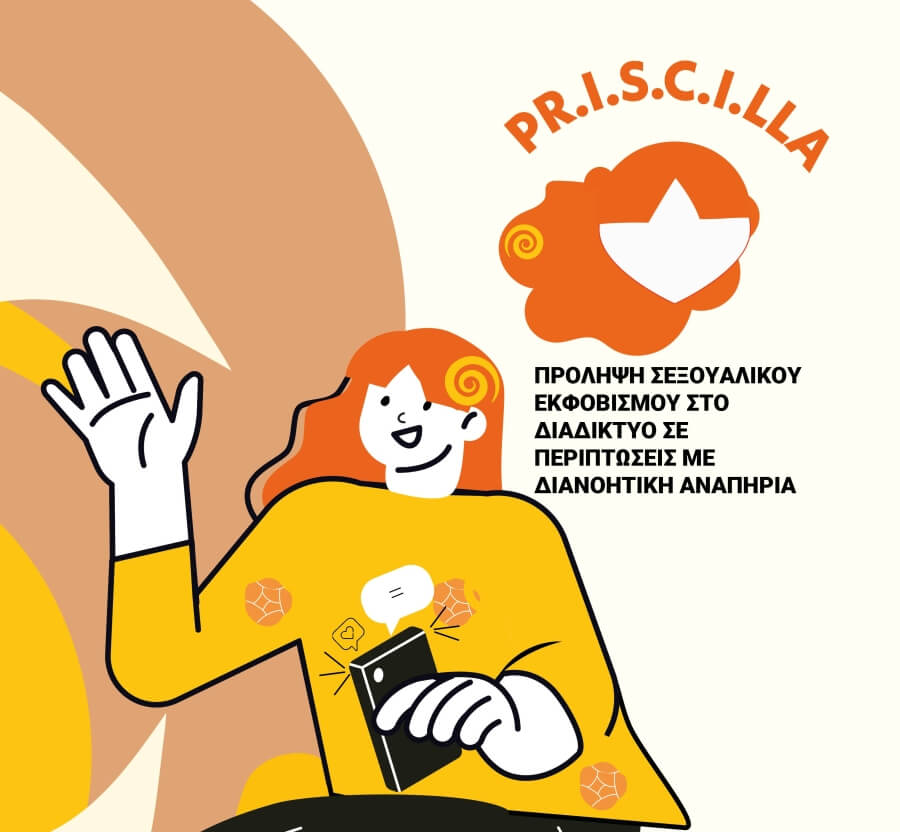
PR.I.S.C.I.L.LA: Educational Programme for Young People with Intellectual Disabilities on Internet Risks and Online Sexual Cyberbullying
The PR.I.S.C.I.L.LA project was developed to prevent and protect against the risks of online sexual cyberbullying, an increasing threat linked to the widespread use of social media. The initiative focuses on young people aged 18 to 25 with intellectual disabilities, responding to the need for guidance and support for their safe and responsible use of social networks.
As part of this effort, a specialised educational programme was created, structured around themes related to online safety and digital well-being. It is designed for implementation in environments attended by young people with intellectual disabilities, helping them use social media as a space for positive interaction, personal development, and self-expression. Its aim is to empower young people, enhancing their identity, self-awareness, and self-esteem, while reducing the risks of sexual harassment and cyberbullying.
Structure of the Educational Programme
The programme’s pedagogical principles include decision-making skills, self-determination, a sense of control, and the promotion of independence. It is based on learning-by-doing, using interactive and practical methods that support active participation and comprehension. These include physical activities, visual aids, role-playing, practical exercises, and storytelling.
The programme consists of five modules:
- Online Relationships vs. Real-life Relationships:
Supports young people in better understanding emotions and their expression. It explains differences between friendship and love, the importance of self-love and independent decision-making. It also explores online and offline relationships with examples of healthy behaviours and signs of toxic dynamics. - Introduction to Social Media:
Presents the most common platforms, reasons for using them, and online communication methods. It includes safe behaviour strategies such as seeking help, using available protection tools, and recognising risks. - Identifying Risks on Social Media:
Focuses on major risks such as cyberbullying, grooming, and data theft. It explains what they are and how to protect oneself. - Safe Use of Social Media:
Emphasises privacy, protection of personal data, and provides practical guidance for safer and more responsible social media use, promoting digital independence and well-being. - Finding Solutions and Seeking Help:
Provides instructions on what to do if a young person experiences cyberbullying, particularly sexual harassment. It includes a step-by-step practical guide and highlights the importance of creating a trusted support network (family, friends, professionals).
The modules help young people with intellectual disabilities to:
- understand that social media can be both helpful and harmful,
- recognise dangerous situations,
- learn strategies for safer use,
- know when and who to ask for support.
Pilot Implementation of the Programme
Key results demonstrated:
- Significant increase in awareness of online risks,
- Strong and stable threat detection skills,
- Clear understanding of privacy and communication concepts,
- A “security paradox” with higher awareness but reduced feelings of safety,
- High confidence in problem-solving abilities,
- More participants acknowledged having experienced cyberbullying.
The training proved valuable not only for young adults but also for younger teenagers and adults, confirming its potential for wider application. The programme’s adaptability facilitated active participation and practical application in daily life. Sessions also contributed to a deeper understanding of interpersonal relationships, appropriate and inappropriate online behaviour, respect, self-respect, use of polite language, and ways of seeking help.
The PR.I.S.C.I.L.LA project demonstrated that inclusive and interactive educational programmes can equip young people with intellectual disabilities with concrete tools for safer and more informed use of social media. The pilot phase showed not only improved skills and confidence, but also the importance of combining knowledge with ongoing emotional support.
Through its innovative and flexible approach, the project lays the groundwork for broader dissemination, aiming to create safer, more inclusive, and more respectful digital communities.
For more information about the PR.I.S.C.I.L.LA project:
Website: https://priscillaproject.eu
Follow updates with the hashtag: #PRISCILLA_PROJECT
Notes to Editors
The PR.I.S.C.I.L.LA project is implemented by a consortium coordinated by ASSOC (Romania) with partners:
- Anziani e non solo (Italy)
- EDRA (Greece)
- INTRAS (Spain)
- KMOP Skopje (North Macedonia)
More about the consortium: https://priscillaproject.eu/#Partners
The information leaflet is available in English, Romanian, Greek, Macedonian, Italian and Spanish: https://priscillaproject.eu/downloads/
Background
There is an increasing need to promote the digital inclusion of young people with intellectual disabilities. While the internet and social media provide opportunities for social interaction, self-expression, and personal development, they also pose serious risks, particularly for vulnerable groups. Young people with intellectual disabilities are more frequently exposed to online threats such as sexual harassment and cyberbullying, which can severely impact their well-being and identity.
The PR.I.S.C.I.L.LA project is co-funded by the Erasmus+ programme (Project Number: 2023-2-RO01-KA220-YOU-000174271).